Ad(s) Infinitum: To Build A Calmer World
Does anybody except the advertising industry even want advertising to exist anymore? This is a question that I now think about more or less every time I see an ad (which is way too often). Our online experience is now: ads at the top of, and mixed into your search results; ads every third social media post you scroll past; ads every five minutes on streaming services; ads on your TV (even when your show is paused, and even when your TV is off); entire genres of content that are ads in themselves (see Amazon’s War of the Worlds (2025) for an extremely embarrassing example); ads on your smart appliance’s screens; ads in the “conversations” with the AI chatbot you’ve replaced your therapist, friends, and family with. Offline is no better: ads at bus stops and train stations, ads on the busses and trains, billboard-sized ads on every blank building face, trucks that will drive around with bright-ass LED signs with ads all over them.
We continue to believe that this is all something – but for what? The prevalence with which advertising has infected every aspect of our lives is deeply sinister. Billions and billions of dollars spent on psychological manipulation to shift your opinion in microscopic increments. It is, in no small way, an aspect of the future dystopia that science fiction writers have been warning us about time and time again – and yet we have arrived here anyway, warnings unheeded.
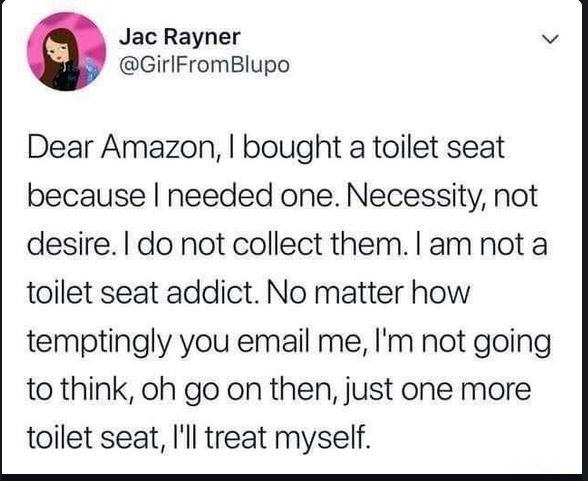
Tainted from its inception, advertising now, laser-focused on influence (subtle or not) to sell, sell, sell – whether that be a product, service , or a political message. The idea that the company’s job is to implant in the customer’s head that their vacuum cleaner is the BEST vacuum cleaner (through advertising), while the executives hedge the entire company’s prospects on whether their advertising will allow them to sell enough vacuums, is absurd. Let alone that the model leads to truly absurd scenarios: you buy a replacement toilet seat, and find yourself inundated with ads for toilet seats for weeks. How does this make any sense? Of course it doesn’t: the model simply requires that companies pay to shill their toilet seat ads until the heat death of the universe (or the data centers). God forbid we live in a world where the consumer is allowed to make decisions for themselves.
Advertising Today
The merger of this model with the rise of our internet-connected society has made it so much more invasive, to the point that it has entirely degraded entire categories of products and services we use every day. Open any news website and immediately be flooded with ads on the side bars, ads where you expect articles to be, ads in headers and footers – entirely inescapable. Social media, popularized as a way to interact with other humans by sharing life updates, photographs, and stories, is now largely made up of influencer advertising and platform advertising – seriously, next time you use Instagram, count how many posts out of the first 30 you see are actual people you know, and how many are ads, whether that be influencers you follow, sponsored content, or “suggested content.”
This is yet another instance of enshittification. Or, rather, this is one of the primary goals of enshittification. Products created for social engagement or commerce now ultimately all have the singular goal of impressing investors and making stocks go up, year after year, forever. Advertising is a requirement to keep companies “profitable,” as these platforms themselves aren’t designed to be profitable themselves – they’re designed to facilitate communication and commerce (this is putting aside the very real costs of infrastructure necessary to run a global commerce or social media site, but there are other ways to do this than advertising. Indeed, it shouldn’t be required for “the place where you share memories” or “the place you buy stuff from” to be profitable. And it is bad enough that an entire economy has popped up around eliminating the onslaught of ads that you must slog through to use a normal website (who among us hasn’t considered YouTube Premium for this exact reason). While this portends its own issue of enabling further takeovers, centralization, and control by large corporations, that conversation is one for a future article.
Technical Issues and Privacy
Advertising in the 21st century poses technical problems as well: how much of global internet traffic is exclusively dedicated to advertising? How much money would we save on data center construction alone if we eliminated the infrastructure set up for the advertising industry? Increasingly, how much of that data is just AI generated bullshit, exponentially increasing the requirements to both create and store that data?
More importantly, the privacy implications of our current advertising model are severe – advertising companies are now tasked with creating hyper-specific profiles of every individual on earth, in order to targets ads at us. Profiles consisting of our posts, our searches, our interests, our politics, and seeking to predict our thoughts, feelings, moods, and desires, all to decide whether we should be served the ad for the newest power tool, the bed-cooling doohickey, the “warmest sweatshirt on earth,” or a ‘biblical’ cure for foot odor (all ads one of us at TBB has been served). Profiles that can be, regularly are, bought by third parties for non-commercial (read: political) advertising, but could also be bought by other bad actors, be they hackers looking to do social engineering to steal your credit card information, a foreign government running an information operation, or our own government tracking its citizens for repression, as we’ve now seen happen with the pro-Palestine and anti-ICE protest movements.
The best example of this is Facebook’s Cambridge Analytica scandal – a third-party advertiser harvesting user data to target political ads, specifically in support of Donald Trump’s 2016 campaign (and look how that turned out…). But this is of course a single example – who else is our data being sold to? In our current environment, are your social media posts, even your ephemeral story posts, being harvested and sold to ICE, plugged into the Palantir predictive algorithm machine to predict whether you’re going to attend a local protests, at which you can be identified by the hat you bought on Amazon two weeks ago, arrested, and rendered to a foreign country against your will? The FBI director, mere weeks ago, admitted that the FBI buys commercial data for location tracking, so the answer might be simpler than you imagined.
What if we...didn’t need advertising? Or, rather, what if we decided to choose privacy over the convenience of letting companies invade every corner of our lives to sell us shit we don’t need. Consider the time you would get back if your 20 minute shows were 20 minutes again, without 5-10 minutes of ad breaks; consider how pleasant our cities could be if we calmed down with the times square-esque flashing LED billboards popping up everywhere; consider the amount of waste we would save from the landfills if we weren’t constantly shucked cheap, drop-shipped products to solve problems that don’t need solving. The bright minds wasting away creating annoying, catchy marketing slogans could put their time into creating real media, things people actually want to watch, read, and listen to. Social media could return to being a way to connect with real people, be that friends, family, or those who share interests with you, all over the world. Life itself would be calmer, easier, better, if we allow our cities to be plastered with real, human artworks rather than corporate slop.
The clear solution here is strong policy – we have to prevent companies from shoving advertising into every service, on every screen we own, in every empty space, and take our time, attention, and sanity back. Enmeshed with this is the need, as a society, to slow down and embrace living that isn’t focused on economic growth above everything. Advertising is such a clear example of capitalist brain rot, and without it we would be better off individually, and as a society, regarding many of the other negative impacts capitalism has on our lives. Ultimately, we cannot keep living like this, and the only viable solution is to all but eliminate this evil industry, and the powers behind advertising, to free us from this hell.