
Decentralization: The Left Must Reclaim...Web3?
The increasing centralization and privatization of technology is strangling our ability to use technology the way we want. There are plenty examples of this, from social media companies’ increasingly restrictive content moderation policies, to nation and state governments imposing bans on entire apps and services. We have, in a very real sense, lost control over our online experience, and have capitulated to an online experience that our corporate overlords want us to have (with limited exceptions–see Tumblr as an interesting example of some resistance to this). But there are ways to begin to take back that control. This article seeks to describe the potential for decentralization to help us reclaim a radically different, people-first online infrastructure and, in turn, reclaim our technological freedom.
From cellular service to internet service to data centers to the power grid, all of the underlying infrastructure of our online experience has become centralized and, increasingly, monopolized. There are three major cellular service providers in the US; other, smaller carriers piggy-back off of one of the three major networks’ infrastructure. While internet service isn’t the exact same kind of monopoly, it operates similarly to the electric companies, meaning that the average person has little choice in their internet service provider, whether that be to a single family home, or an apartment in a bigger building. Further, the data centers that process and hold all of our data are increasingly owned by just three big companies–Amazon, Google, and Microsoft–who own and continue to build the lion’s share of data centers, giving just a few companies complete control over your online experience.
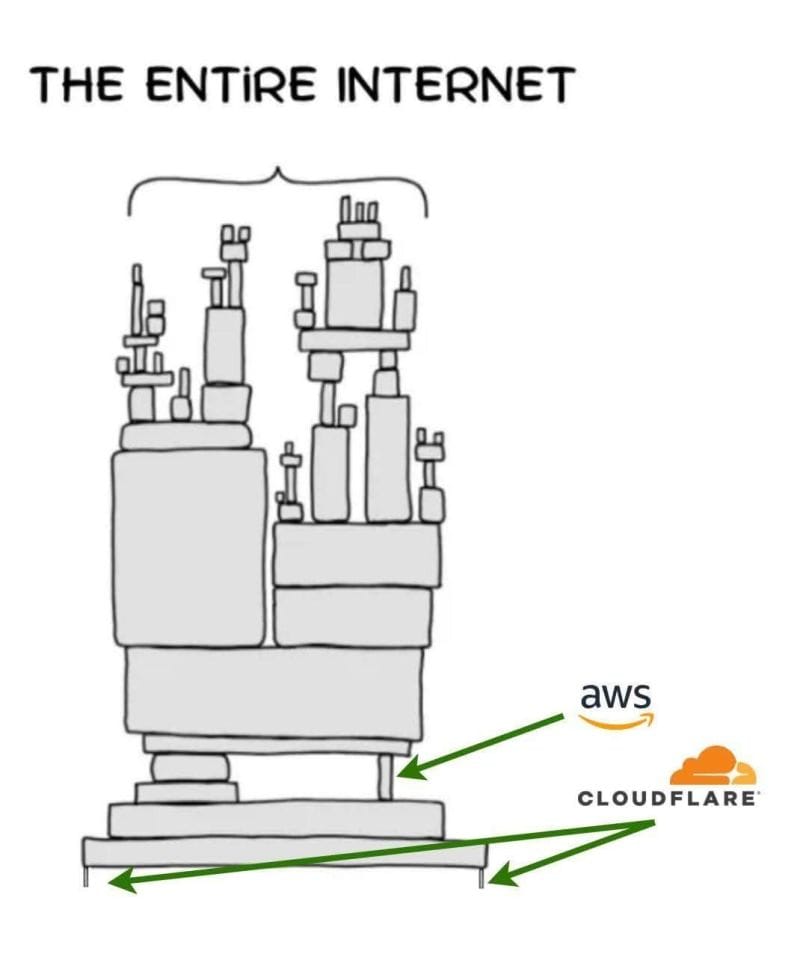
Given the precarious nature of this infrastructure, it is no wonder that we’ve had massive online service outages linked to mis-configured provider infrastructure, from a singular Amazon Web Services (AWS) gateway to a broken CloudFlare software update...twice. Regulation is key to ensuring that these companies are both held accountable for mistakes and pushing them to improve both security and stability, and while we wait for monopolies to be broken up, costs for these services also continue to climb. We need a new paradigm-a decentralized alternative–one that will remove the profit motive (and resulting enshittification) from the equation, and turn over control of the internet to the people.
Decentralization is the process of creating distributed networks to eliminate reliance on the current models of online infrastructure–that is, implementing smaller-scale networks that allow for data sharing and processing without requiring a massive tech company’s data center, but that can all link together to create a network of networks, similar to how the early internet was set up (clusters of researchers at universities, each linked together by a single cable, simply put).
Web3 and, Unfortunately, Crypto
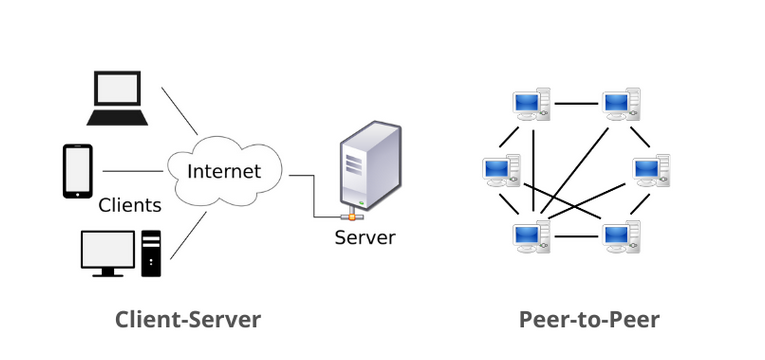
This article won’t cover Web3 and its sub-components in great detail, but it is important to note that these concepts have implemented (albeit poorly) some fundamentals of what a true decentralized internet could look like. Web3 as a project saw the issues surrounding the consolidation of power online to massive companies as problems worth solving, and emphasized the very word decentralization in its messaging, highlighting privacy-enhancing tools like Blockchain technologies that would allow for both decentralized transactions and privacy from big tech. Blockchain uses a distributed ledger system which relies on Peer-to-Peer (P2P) communications to provide the above security and privacy, in contrast with the current client-server model of almost all online infrastructure.
Unfortunately, the communities of Web3 and Blockchain technologies (venture capitalists and right-libertarians) were still largely interested in using technology to make money, resulting in web3 becoming the foundation for the entire Cryptocurrency industry becoming what it is today–mostly a vehicle for funding illicit activities, scams, and fraud, including NFT’s and the “crypto-rug-pull,” both scams that have now been run by the President of the United States (very cool and normal!).
The fundamental concepts behind what Web3 wanted to be, including the idea of decentralizing transactions online, remain good. Critically, Blockchain isn’t the only existing model of distributed internet infrastructure. Other groups of researchers, programmers, and activists have created secure protocols and software, like Secure Scuttlebutt and Meshtastic, intended to act as components of alternatives to using the existing internet, that forego the inherent profit focus and extraction framework tied to Blockchain and Cryptocurrency.

Thankfully, we need not start from scratch, given much of the infrastructure is already in place (though effectively decentralizing some of it will be a challenge). According to the UN’s International Telecommunications Union (ITU), around 75% of the world population had internet access in 2025. We already have massive undersea cables connecting continents, and the infrastructure, wired or wireless via satellite, necessary to connect us, though there is still a lot of work to be done on this front (the Biden administration’s plan to provide improved fiber internet connections to thousands of rural Americans was recently obliterated by the Trump Administration, because of course it was). Of course, we will still need to manage this infrastructure, but having it controlled by an increasingly small number of private companies who can change and remove content, or eliminate services because they are no longer profitable, or because their leadership caves to political pressures, is a problem. Further, globalizing a decentralized model will require a greater focus on solutions for the parts of the word with no existing infrastructure, a problem deeply intertwined with the greater issue of our Capitalist system requiring a poor “Global South” in order for the rich and powerful to remain rich and powerful.
The amount of computing power each personal computing device has today is astounding, even as we may be approaching the limits of Moore’s law. While, sure, data center “computers” are significantly more powerful than the average smartphone, the devices we already own could serve some of the core functions of distributed systems (yes, you can actually host a website on a modern smartphone!). The foundation of a new system would rely not just on changing the physical and logical way our devices interact, but also re-imagining how we use the internet. Messaging done through P2P protocols like the above mentioned Secure Scuttlebutt, allowing message data to be stored on our devices or on a local repository, rather than living on a tech company’s data center. Secure financial transactions could be conducted directly between you and the person you are transacting with, without hopping through intermediaries or sending your sensitive data through other, untrusted systems.
So what can I do?
There are plenty of ways to begin to eliminate some of big tech’s influence on your life, and rely more on smaller services and providers that focus on protecting your privacy and your data. However, the core issue of decentralization is not one that can be implemented by you, alone. After all, if completely eliminating these big tech companies from our lives was easy, they probably wouldn’t continue to exist, let alone force us to increase our reliance on them. This is where these decentralization technologies come into play. Learning about, testing, and implementing these alternatives is something you can do with a small group of friends, be that a social group, a political action group, or even just you and a buddy. Governments are continuing to apply pressure to tech companies, and it is our prerogative to begin to pry away the avenues of influence they have over us.
These types of decentralized systems will only function if we proliferate these technologies among large numbers of people. We encourage you to learn, tinker, and build with some of these technologies and share this knowledge with people in your life. This will ultimately benefit you, those around you, and all of us as it contributes to chipping away at big tech’s oligopoly over our attention, time, and lives. Our technology resources page will be continually updated with some more ways you can begin to eliminate some of these corporate services from your life, and better protect your own data. We also can’t thank enough the groups who have been doing this work for decades, including the Electronic Frontier Foundation (EFF), for their persistent focus on developments in the decentralized internet space as a component of digital sovereignty. In a world that wants to keep you ignorant and complacent, read, learn, and create; these are our biggest weapons against big tech.